
CAEPA REINFORCES WATER SUPPLE IN MEZAM DIVISION, NWR.
Urbanisation can benefit communities through modern infrastructure, innovation and employment opportunities. However, it can also place considerable pressure on forests, water catchments and other natural resources when development is not properly managed.
Development often involves the clearing of existing forests, placing immense strain on local water-supply systems. When rural communities experience a rapid influx of inhabitants, the demand for water increases and residents may be forced to depend on unsafe or contaminated water sources.
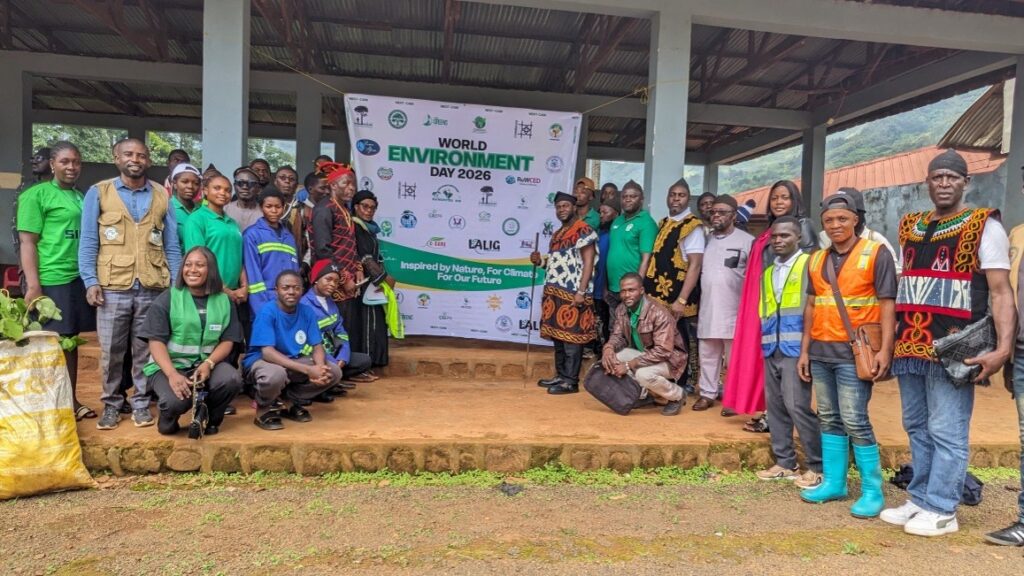
To address the growing challenge of water scarcity, the Community Agriculture and Environmental Protection Association commemorated World Environment Day by championing two major environmental initiatives in the North West Region of Cameroon. The interventions focused on protecting the environment, restoring water catchments and reinforcing water sources within the city of Bamenda.
Environmental Action at a Glance
Protecting the Bamendakwe Watershed
Together with other environmental stakeholders, CAEPA commemorated World Environment Day at the Bamendakwe Fon’s Palace. During the event, the organisation donated 500 water-friendly and ornamental trees to the community through His Royal Highness Fon Forchesiri III.
Bamendakwe is widely recognised as an important watershed area. Protecting its natural environment is vital to securing water sources for future generations, particularly because water from the area flows into several other localities within Mezam Division.
It was on this basis that CAEPA Cameroon, together with other humanitarian and environmental actors, donated tree seedlings to the community. To mark the occasion, seedlings were planted around five water catchments.
Planting trees in these strategic locations is essential for protecting the soil, reducing erosion, improving water infiltration and restoring catchments for continued community use.
Environmental protection is a responsibility that we all share, and I am delighted by this partnership beginning today. Bamendakwe is a watershed, and there is every need to protect it. More importantly, we must carry out sensitisation sessions involving people of all age groups.
The Fon also highlighted the traditional conservation practices undertaken by community members. According to him, every young man who comes of age is traditionally expected to plant a fig tree during his lifetime.
This is our way of sustaining environmental protection. To us, every public space should have a fig tree. Local stakeholders have a duty to ensure this is done, not only as a cultural practice, but also for future generations.
He explained that the donated trees would be handed over to zonal community heads, who would mobilise residents within their respective zones to plant, protect and regularly nurture the seedlings.
Community Dialogue on Local Environmental Action
The donation ceremony brought together environmental experts, traditional rulers, community members, humanitarian actors and students. As part of the event, participants held a round-table discussion under the theme: “Local Actions and How They Affect the Community.”
During the discussion, participants observed that many of the challenges affecting environmental protection are directly linked to human activity. Poor waste management, deforestation, uncontrolled urban expansion and other harmful practices were identified as major contributors to environmental degradation.
Stakeholders warned that these challenges require immediate and coordinated intervention to prevent communities from experiencing worsening water scarcity, pollution, land degradation and climate-related risks.
Proposed Community Solutions
- Increasing tree planting and forest conservation.
- Strengthening pollution prevention and control measures.
- Increasing community participation, education and sensitisation.
- Protecting and restoring water catchment areas.
- Promoting climate-change adaptation and resilience within communities.
- Encouraging the use of organic manure in agriculture.
- Protecting rare, threatened and environmentally important species.
The Divisional Delegate of Environment reiterated the message of the United Nations Environment Programme, calling on communities throughout the North West Region to invest in protecting nature, strengthen climate-change adaptation and act today to secure the future.
Supporting Agroforestry in Ntambang
As part of the World Environment Day activities, CAEPA also donated trees to SACOD and actively participated in planting them to support environmental restoration.
At the implementation site in Ntambang, SACOD and CAEPA mobilised indigenous women to participate in protecting their environment. CAEPA donated 100 fruit trees to support the activity, which contributed to the planting of approximately 500 tree seedlings in the Bamenda III area.
The initiative represents an important step towards expanding agroforestry, improving food security, restoring degraded land and strengthening community resilience.
Community Engagement
Women, young people and children gathered along the main streets of the Ntambang neighbourhood to participate in the tree-planting exercise. Their involvement demonstrated the importance of community ownership in achieving lasting environmental restoration.
Participants stood in organised rows as CAEPA staff distributed seedlings contained in black nursery bags. One by one, the community members received their seedlings and waited for instructions on the appropriate planting procedures.
Before the planting began, CAEPA educated participants about the importance of trees and the dangers of deforestation, particularly as the community gradually transforms from a rural settlement into a more densely populated urban area.
The sensitisation session was followed by practical planting activities. Women and young people carried their seedlings to household compounds and public spaces. They prepared planting holes, carefully removed the nursery bags, placed the seedlings into the soil and covered the roots securely.
The trees are intended to combat environmental degradation, improve food security and create opportunities for greater economic independence among Mbororo Fulani women in the Bamenda III Subdivision.
We have partnered with environmental actors to protect our environment and reinforce water sources as part of our responsibility to the planet. Partnerships at this level are important because no individual organisation can restore the climate alone.
As the planting continued, the CAEPA team supervised the exercise to ensure the seedlings were planted correctly and had the best possible chance of survival and future productivity.
A Long-Term Commitment to Environmental Stewardship
This year’s engagement represents CAEPA Cameroon’s renewed commitment to environmental stewardship, climate action, sustainable development and the protection of community water sources.
CAEPA believes that environmental protection cannot be treated as a one-day event. For this reason, the organisation intends to continue its interventions beyond the World Environment Day activities.
At the time of this report, CAEPA had identified seven water catchments across Mezam Division where additional trees would be planted to restore water sources and deliver long-term benefits to surrounding communities.